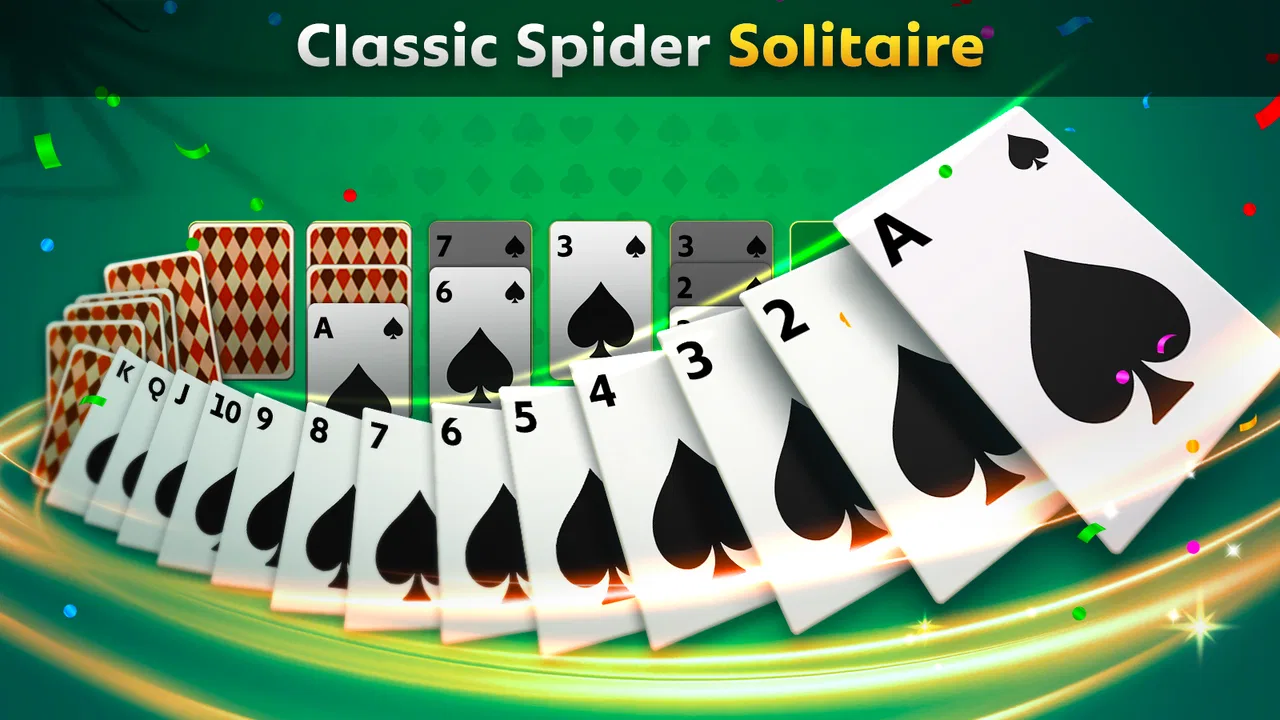
Spider Solitaire
- 4.6
- Rating
- 1.00M
- Installs
- Free
- Price

 Analysis by App-foxy
I keep coming back to card games when I want something absorbing without committing to a long session, and this Spider Solitaire release fits that mood particularly well. It focuses on the familiar solo card format rather than trying to turn it into a complicated social game, so I can open it for a brief break, think through a difficult layout, and leave whenever I need to. That straightforward purpose is its biggest strength.
Spider Solitaire is a free card game from Gimica GmbH, built around classic Spider Solitaire and Spiderette play. It also includes daily challenges, badges, and events, which give the traditional format more direction when I want something beyond starting another random deal. The game is rated for Everyone, and its current version is 1.3.0, making it an easy recommendation for households looking for a simple, age-friendly card pastime.
How the game feels in everyday use
The first thing I noticed is how quickly the game gets to the point. A Spider Solitaire session does not need a tutorial-heavy opening or a long setup process. I can choose a deal, begin sorting cards, and settle into the familiar rhythm of building descending sequences. That makes it a good companion for small gaps in the day, such as waiting for an appointment or taking a quiet break after work.
You May Also Like

 Blood Strike: 2.5 Anniversary
Blood Strike’s Loadouts Turn Every Drop Into a Tactical Gamble
A close look at Blood Strike’s custom loadouts: how fast access to signature weapons reshapes its battle royale rhythm, rewards preparation, and narrows the gap between fights.

 Pandora - Music & Podcasts
Pandora’s Music Is Easy to Start, but Harder to Recover
Pandora’s strength is its low-effort path from a seed to a station. Its weak spot is how much confidence it asks you to place in connection, setup, and quiet recovery.

 8 Ball Pool
 Is Built on Rivalries, Rematches, and Routine
A close look at the rivalries, rematches, shared routines, and unanswered safety questions that turn a quick pool match into a persistent mobile community.

 Samsung Music
’s Quiet Strength Is Playing What You Already Own
Its reach comes less from spectacle than from dependable access to a personal library. That simplicity is both the app’s strongest retention engine and its ceiling.

 AccuWeather: Weather Radar
AccuWeather Review: A Quick, Clear Forecast for Everyday Decisions
For everyday plans, the best forecast is the one you can understand quickly. AccuWeather makes rain timing, radar, and local conditions easy to act on, with a few trade-offs.

 Hill Climb Racing
Why Hill Climb Racing Still Turns Crashes Into One More Run
A tiny car, a bumpy hill and one more upgrade: Hill Climb Racing keeps resurfacing because its simple chaos makes every near-miss feel personal.
More From Our News Desk



Spiderette is especially useful when I want a shorter, more compact variation. It changes the shape of the challenge without abandoning the basic card-solving appeal. I would not treat it as a completely different game, but having both formats available helps prevent the experience from feeling like one repeated routine. For a player who already knows Spider Solitaire, that variety is more meaningful than a collection of unrelated mini-games would be.
The game’s speed expectations are modest in a good way. This is not an action title that needs rapid reactions, complex animation, or constant network activity to be enjoyable. Its main performance demand is the smooth handling of a card layout and the response to taps or drags. On a compatible device, I would expect the core interaction to feel light because the game is based on a restrained card table rather than a visually dense world.
That does not mean every moment will feel equally effortless. A difficult deal can make the game seem slower simply because I am pausing to inspect possible moves. That is a thinking delay, not necessarily a technical one. The distinction matters: when I am deciding whether to expose a hidden card or preserve an empty column, the quiet pace is part of the appeal.
Why the classic format still works
Spider Solitaire rewards planning more than luck alone. I have to consider which sequence to move, when to create an empty column, and whether a temporary arrangement will open useful cards later. That gives each session a small puzzle-like structure. Even when I lose, I usually understand which decision narrowed my options, which makes the next attempt feel purposeful rather than random.
The addition of daily challenges gives routine players a reason to return with a specific objective. Badges and events serve a similar role for people who enjoy visible progress. I see these elements as optional motivation rather than the heart of the game. If I only want a calm card session, the classic format remains the main attraction; if I want a longer-term reason to play, the extra goals add some structure.
One useful habit is to treat the daily challenge as a warm-up instead of immediately using it as a test of skill. I can play a regular round first, pay attention to how the game presents moves, and then approach the challenge with a clearer plan. This is a small workflow change, but it helps avoid turning a relaxing game into a frustrating obligation.
What happens during longer play sessions
Heavy-use moments are unlikely to come from a single dramatic match. They are more likely to happen when I play several deals in succession, move repeatedly through the same menus, or spend a long period chasing badges and event progress. In those situations, the important question is not whether the game can produce spectacular graphics; it is whether the interface remains comfortable and the session still feels mentally manageable.
For me, the main resource cost is attention rather than hardware power. Spider Solitaire can encourage “one more deal” behavior because each round is compact and the next attempt is always easy to start. That is convenient, but it can also make a short break stretch longer than planned. I would set a personal stopping point before opening the game if I had a busy schedule.
Long sessions also expose the game’s repetitive side. Daily challenges, badges, and events can refresh the purpose of a session, but they do not change the underlying card mechanics. Players who need constant novelty may find the loop too narrow. Someone who enjoys gradual improvement, however, may appreciate seeing the same fundamentals from different angles.
A practical approach is to alternate between the standard mode and Spiderette instead of grinding one format. The shorter variation can reset my attention when a full Spider layout starts to feel familiar. I also find it more sensible to pursue badges naturally rather than forcing every round around a reward, because chasing progress can make thoughtful card play feel mechanical.
Stability, interruptions, and recovery
Reliability matters more in a casual game than many people expect. I often play these titles in situations where I may need to put the phone down quickly. A useful solitaire app should fit around those interruptions instead of demanding a long uninterrupted commitment. This game’s basic format is well suited to that pattern because a round can be approached in small pieces.
Still, I would not confuse short sessions with guaranteed recovery from every interruption. Any card game can become inconvenient if an unfinished arrangement is not preserved exactly as I expected, or if I accidentally leave a round while navigating elsewhere. My advice is simple: before switching apps or locking the screen during an important deal, make sure the current game is in the state you want to keep. That habit reduces the risk of losing concentration even when the device itself behaves normally.
The presence of events and daily activities also makes timing more relevant than in a completely offline-feeling solitaire clone. If I care about completing a particular activity, I would open the game when I have a stable moment rather than beginning it while moving between tasks. This is less about demanding performance and more about protecting the continuity of the session.
Gimica GmbH has kept the product focused enough that I do not expect the same kind of reliability concerns associated with larger games containing many interconnected systems. There is no need for me to manage a complicated character build, a large inventory, or a demanding real-time match. That narrower scope is reassuring, especially for players who want a card game that stays understandable after weeks away.
Device limits and everyday practicality
The game supports Android 7.0 and later, so it is not restricted to only the newest phones. That broad compatibility is useful for anyone keeping an older device as a secondary phone or sharing a family tablet. I would still judge the experience by the particular device’s general condition, because an older phone with limited free storage or an aging battery can make any app feel less responsive.
Its card-table design should be easier on a device than a modern three-dimensional game, but I would avoid promising identical behavior across every handset. Screen size can affect comfort, especially when several columns are visible and I need to distinguish cards quickly. On a smaller display, tapping carefully becomes more important, while a larger tablet screen may make the layout easier to read during long sessions.
Resource demands also depend on how the game is used. A brief standard round is a light workload in practical terms, whereas repeatedly browsing challenges, badges, and events creates more menu activity. If my phone is already struggling with many background apps, I would close unnecessary programs before playing—not because this game is inherently demanding, but because reducing competition for memory is a sensible way to improve any casual session.
Storage and battery are worth considering without exaggerating them. A card game does not need the visual assets of a large adventure title, yet every installed app occupies some space and every active screen consumes power. On an older battery, I would not leave the display on for an extended event session while away from a charger. That is ordinary device care, but it is particularly relevant when a relaxing game encourages longer play than planned.
Free access and the role of purchases
The game is free to download, which makes it easy to try without making the first decision a financial one. In-app purchases range from $0.99 to $3.49 per item. I would approach those purchases as optional spending rather than part of the basic reason to install the game. The important question is whether I enjoy the card play before I consider any extras connected with continued use.
That pricing range is relatively approachable for a player who chooses to spend occasionally, but small purchases can add up when repeated. My own rule would be to decide in advance whether I am playing purely for the classic card experience or whether the reward systems genuinely add value for me. If I am only looking for a quiet solitaire table, I would not let badges or events pressure me into buying anything.
This is also where the game differs from a very bare-bones solitaire alternative. A minimal clone may feel cleaner because it removes progression prompts and event-oriented motivation. Spider Solitaire offers more reasons to return, but that extra structure can be either a benefit or a distraction depending on my preferences. Players who dislike any sense of collection or ongoing goals may prefer the simpler option.
Who will enjoy it most
I would recommend this game to someone who already likes solo card puzzles and wants more than one familiar format. It suits players who enjoy making careful decisions, replaying after a mistake, and setting small personal goals. The Everyone rating also makes it a comfortable choice for a broad audience, including people who want a straightforward game rather than a competitive or socially demanding experience.
It is a particularly good fit for short, repeatable routines. I can imagine playing one deal with coffee, returning to a daily challenge during a lunch break, and using Spiderette in the evening when I want something less involved. The game does not require me to learn a large ruleset before I can enjoy it, which is helpful when I am introducing solitaire to someone who has not played recently.
The install base is already over 500 thousand, while the average rating is 4.6 from around 28 thousand ratings. Those figures suggest that the game has found a substantial audience, but they should not replace personal testing. Solitaire preferences are unusually subjective: some players want a rich progression layer, while others want nothing between them and the cards.
I would skip it if I need competitive multiplayer, a story campaign, or dramatically changing challenges. The daily activities may give the familiar format more purpose, but they do not transform it into a social card battle or a narrative adventure. I would also look elsewhere if I become irritated by repeating the same fundamental decision cycle, even with Spiderette and event goals available.
How it compares with familiar alternatives
Compared with a classic desktop-style solitaire installation, this release feels more oriented toward returning play. The daily challenges, badges, and events give me reasons to open it again instead of treating each deal as an isolated puzzle. That is its clearest advantage over a completely plain alternative. The trade-off is that players seeking a distraction with no ongoing layer may find the added goals unnecessary.
Compared with other Spider Solitaire games, the important distinction is not the basic rules, which are familiar, but the balance between traditional play and repeat engagement. Having Spiderette alongside the main format gives me another way to use the same card skills. I would choose this game over a single-mode version if I wanted that variation, while a minimalist app might be better for someone who values an extremely stripped-down presentation.
It also occupies a different space from broad card collections that bundle solitaire with many unrelated games. A collection can offer more variety, but it may be less focused. Here, the identity stays centered on Spider play. That focus is useful when I know exactly what I want, although it means I should not install it expecting a complete library of every classic card game.
Small strategies that improve the experience
My first practical tip is to protect empty columns whenever possible. They are not merely empty spaces; they are temporary work areas that let me move longer sequences and expose hidden cards. Spending one too early can make a deal look impossible even when the original sequence of moves was promising.
Second, I try not to build a beautiful descending run if doing so prevents me from revealing a covered card elsewhere. The most attractive move is not always the most useful one. In the daily challenge, this matters even more because the desire to progress can encourage quick moves before I have checked the whole layout.
Third, I use Spiderette as a change of mental pace rather than as a backup after losing. Starting it when I am still patient helps me notice its different rhythm. If I wait until I am frustrated, I tend to rush the shorter format and miss the planning that makes it satisfying.
Finally, I separate performance problems from difficult deals. If cards respond normally but I am repeatedly stuck, I change my strategy before blaming the device. If the interface feels sluggish across several actions, I pause, close other demanding apps, and reopen the game only after giving the phone a moment. That simple diagnostic habit prevents me from misreading a challenging puzzle as a technical failure.
My overall performance verdict
After looking at the game as both a card pastime and a mobile app, I see its strongest quality as controlled simplicity. It should suit ordinary breaks, older compatible Android devices, and players who want a familiar puzzle with a few reasons to return. The hardware expectations are comparatively gentle for this type of game, while the real long-term demand is the player’s willingness to enjoy repeated card decisions.
The limitations are equally clear. It will not satisfy someone searching for deep genre variety, fast action, or multiplayer competition. The ongoing challenges, badges, and events add motivation, but they cannot remove the inherent repetition of Spider Solitaire. Purchases are available, so I would keep my spending intentional and decide whether the extra engagement is actually improving my sessions.
Overall, I would recommend Spider Solitaire to a friend who wants a focused, free card game that works in short bursts and still has enough structure for regular play. I would start with ordinary deals, try Spiderette when I want a different pace, and treat the daily activities as optional goals rather than obligations. That approach makes the game feel relaxed, dependable, and appropriately modest—exactly what I want from a mobile solitaire experience.
FAQs for Spider Solitaire
01What features does Spider Solitaire offer?
Spider Solitaire offers a classic card game experience with multiple difficulty levels, allowing players to choose between one, two, or four suits. The app includes customizable backgrounds, card designs, and daily challenges to keep gameplay engaging. Additionally, it provides an undo option and hints to assist players in strategizing their next moves.
02Is Spider Solitaire free to download and play?
Yes, Spider Solitaire is free to download and play. However, it may include in-app purchases and ads. Players can opt to buy premium features or ad-free experiences. These purchases are optional, and the core game remains accessible without spending money.
03Can I play Spider Solitaire offline?
Yes, Spider Solitaire can be played offline, making it a great option for those who want to enjoy the game without an internet connection. This feature is particularly useful for playing during travel or in areas with limited connectivity, ensuring uninterrupted gameplay.
04Is Spider Solitaire available on both Android and iOS?
Spider Solitaire is available on both Android and iOS platforms, ensuring accessibility for a wide range of users. It can be downloaded from the Google Play Store for Android devices and the App Store for iOS devices, making it easy to get started no matter which device you have.
05Does Spider Solitaire offer any accessibility features?
Spider Solitaire provides several accessibility features to enhance user experience. These include adjustable difficulty settings, optional hints, and an undo move function. The app also supports various screen orientations and sizes, ensuring that it is comfortable for all players, including those with visual impairments.
Pros
- Intuitive interface enhances user experience.
- Multiple difficulty levels for all players.
- Offline mode available for uninterrupted play.
- Customizable themes add personal touch.
- Daily challenges keep gameplay fresh.
Cons
- In-app ads can be intrusive at times.
- Limited hints may frustrate new players.
- No multiplayer option for social play.
- Sound effects lack variety and depth.
- Few updates with new features or modes.

Spider Solitaire
Gallery